
Repowering Onshore Wind
14 January 2026

Seb Watson
Head of Infrastructure Investments, UK & Ireland
Infrastructure Investments
In July 2025, the UK Government’s Onshore Wind Taskforce Strategy1 highlighted repowering onshore wind as one of its main priorities and launched a consultation on permitted development rights to make upgrading existing sites faster and more consistent across the country. This builds on the decision by the Department for Energy Security and Net Zero which allowed repowering projects to apply on the Allocation Round 7 of Contracts for Difference, giving them access to the same support framework as new onshore developments.2
Scotland’s National Planning Framework 43 also recognises repowering as a key element of national energy policy. It supports the continued use of existing wind sites where upgrades can be delivered efficiently and in a way that provides clear benefits to local communities.4
Recent policy momentum indicates growing government focus on maximising the potential of existing wind infrastructure to help achieve the country’s net zero goals.
How Repowering Works
Repowering refers to the process of upgrading or replacing existing wind turbines with newer, more efficient models.
Early onshore wind farms were built with turbines around 60 metres tall with blades spanning 40 metres, while modern designs now surpass 150 metres hub heights and 70 metre blade lengths.5 The extra height allows blades to reach stronger winds higher in the atmosphere, and larger rotor diameters capture more energy with every rotation. For sites with favourable wind resource, larger turbines can improve electricity output by an additional 50% or greater from the original site.6
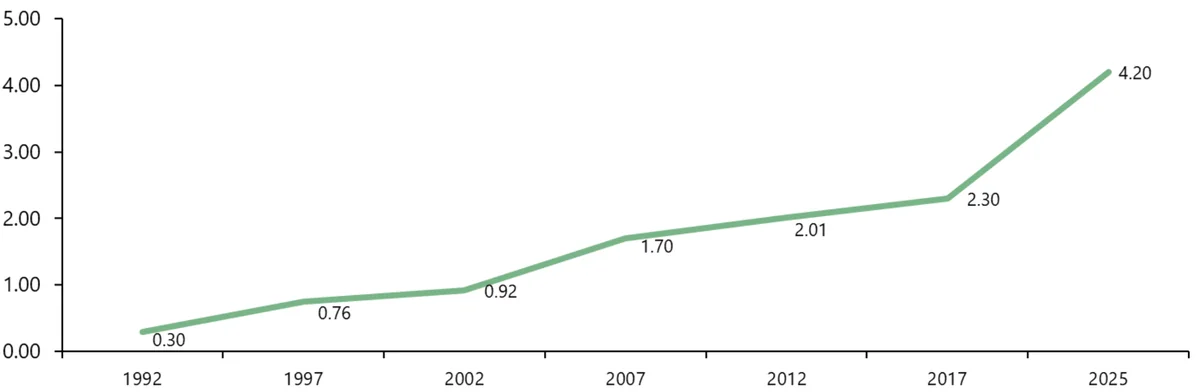
Therefore, repowering offers the potential to boost generation without the need for greenfield expansion: during the 1990s, the average onshore turbine in the UK had a capacity of less than 1MW, whereas turbines installed today are typically rated at 4–5 MW.7
Average UK Turbine MW Capacity (Onshore Wind) by Operational Year
When a wind farm is repowered, much of the original site infrastructure can be retained. Existing grid connections, access roads and substations are incorporated into the new design. Reusing infrastructure lowers the project’s embodied carbon, since less concrete, steel and transport are needed than in new construction projects.
Further, recent advances in material engineering have increased the reliability of wind turbines. The use of carbon-fibre composites in blades allows them to better withstand fluctuating loads and harsh environmental conditions. New blades also face less fatigue and wear, reducing the need for unscheduled maintenance. As a result, modern turbines are designed to operate beyond their original 20–25-year lifespan, extending the productive life of wind assets.8
Scale of Opportunity in the UK
The UK currently has around 15 GW of operational onshore wind and is targeting 27–29 GW by 2030 under the UK Clean Power 2030 Action Plan.9 Achieving this will depend not only on building new capacity but also on preventing the loss of existing generation as early wind farms reach the end of their 25-year lifespans.
UK Onshore Wind Capacity Reaching 25 Years of Operation
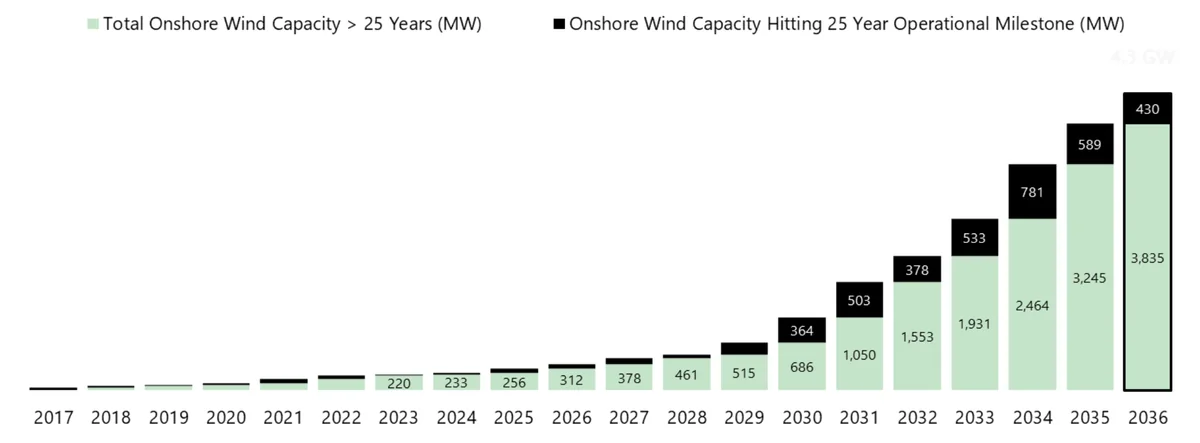
A significant volume of capacity will hit this milestone through the 2030s.10 Without repowering, much of it risks being retired. Modernising these sites offers the chance to both preserve output and increase total capacity within existing footprints.
Risks and Considerations
Despite strong policy momentum, repowering still faces regulatory hurdles that can affect delivery timelines and project economics. Planning processes remain variable across local authorities, and even existing wind farms often need new consents due to the different characteristics of modern turbines. Grid capacity is another constraint, particularly in Scotland and northern England, where congestion and connection delays can limit new generation.11
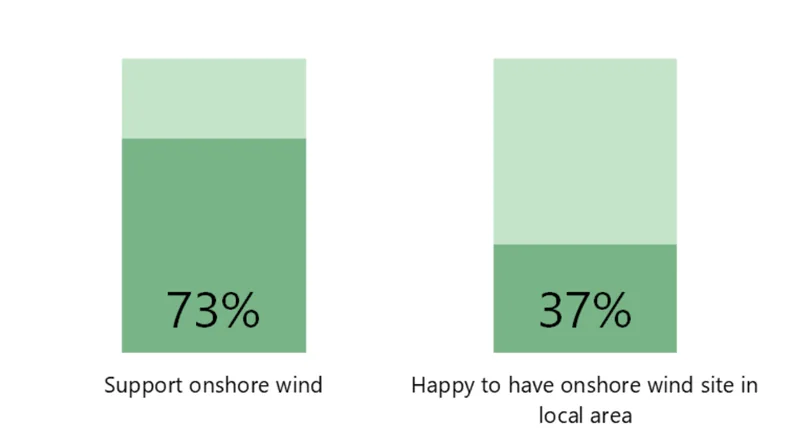
Community acceptance also remains an important factor. Larger turbines can increase visual impact, and construction activity can cause local disruption. While public support for onshore wind remains strong, local acceptance is more nuanced, with fewer people comfortable having developments in their immediate area.12 Early engagement and careful site design are essential to maintaining support.
Public Support for Onshore Wind Farms in the UK, Spring 2025
Technical studies are also necessary to assess the suitability for reuse of existing civil infrastructure such as roads, foundations and on-site substation buildings. In addition, the transportation of larger wind turbine components presents logistical challenges in transportation routes.
The Investment Case
- Proven sites with existing land rights, grid access and operational data reduce development risk compared with new builds.
- Eligibility for 20-year Contracts for Difference provides protection from wholesale price volatility.
- Modern turbines deliver higher capacity factors and have longer operating lives.
- Reuse of infrastructure cuts capital costs and shortens construction timelines.
- Repowering increases generation without expanding land use, supporting national decarbonisation goals.
- The pipeline of ageing assets creates a visible, multi-year pipeline of projects suited to long-term infrastructure investment.
- 1Department for Energy Security and Net Zero, 2025, Onshore Wind Taskforce Strategy
- 2Department for Energy Security and Net Zero, 2024, Proposed amendments to Contracts for Difference for Allocation Round 7 and future rounds
- 3Scottish Government, 2023, National Planning Framework 4
- 4US Department of Energy, 2024, Wind Turbines: the Bigger, the Better
- 5Locogen, 2025, Repowering: a strategic route to net zero delivery
- 6Department for Energy Security and Net Zero, 2025, Renewable Energy Planning Database: quarterly extract, July 2025
- 7Firoozi, A., Firoozi, A., and Hejazi, F., 2024, Innovations in Wind Turbine Blade Engineering: Exploring Materials, Sustainability, and Market Dynamics
- 8Department for Energy Security and Net Zero, 2024, Clean Power 2030 Action Plan: A new era of clean electricity — main report
- 9RenewableUK, 2025, UK wind energy database
- 10Department for Energy Security and Net Zero, 2025, Renewable Energy Planning Database: quarterly extract, July 2025
- 11UK Energy Research Centre, 2025, Transmission Network Unavailability — the Quiet Driving Force Behind Rising Curtailment Costs in Great Britain
- 12Department for Energy Security and Net Zero, 2025, Public Attitudes Tracker: Spring 2025 — Crosstabulations